
There isn't a prize for being uncomfortable.
Hi Kula Cloth friends!
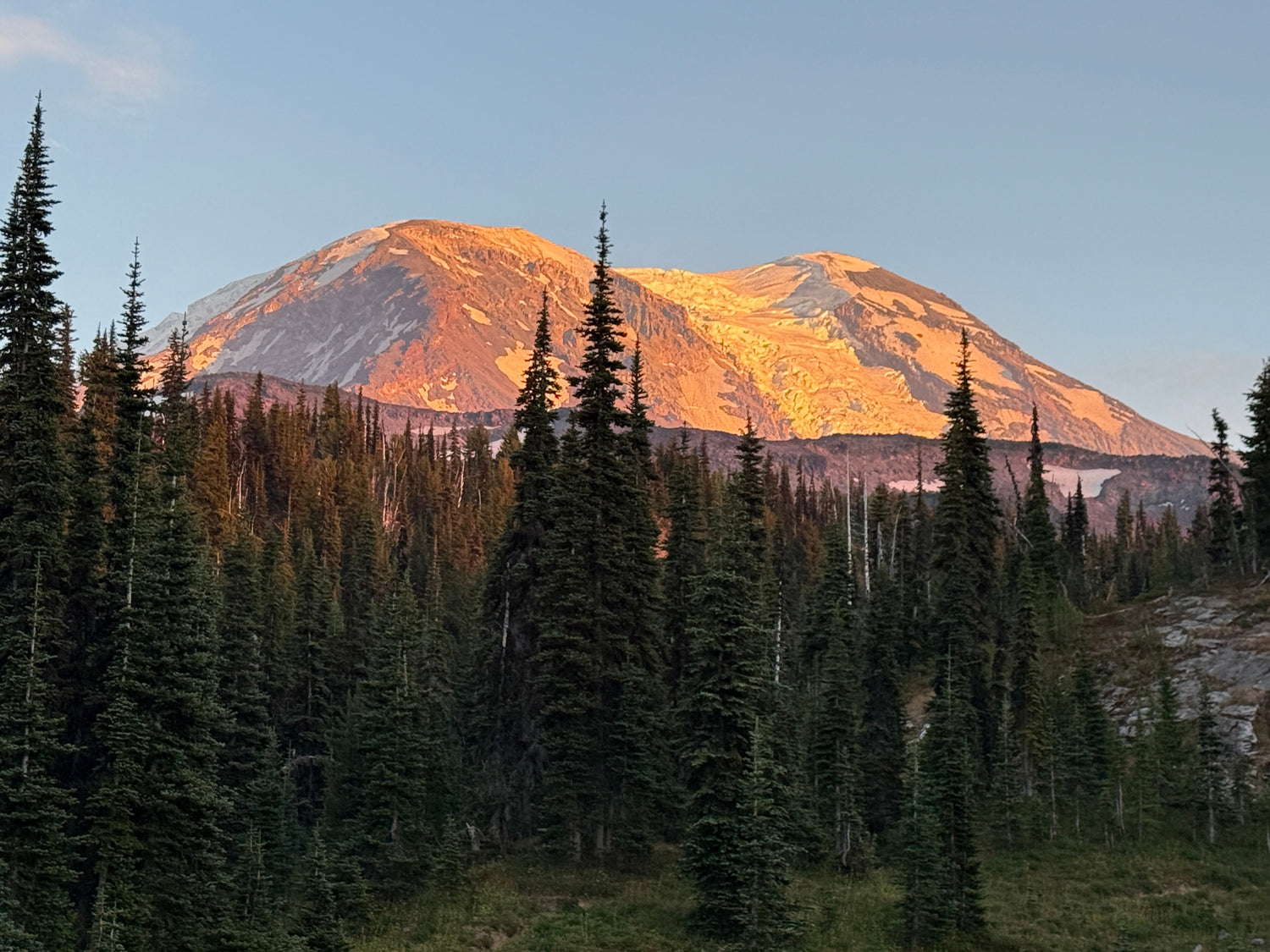
This past weekend, I headed out on a two-night backpacking trip with my mom, my husband Aaron, and our friend Anne. We went to a beautiful spot on the flanks of Mount Adams, where we would spend both nights at the same little base camp and head out for a day hike on our second day.

As a former park ranger, backpacking instructor, and somebody who has spent a LOT of time wandering around outside with a backpack on, I've learned something very important about backpacking gear:
There is no single perfect backpacking gear list.
In fact, one of the most important things I can tell you is that you should not be using a static gear list for every trip.
I've seen backpacking gear lists online that are incredibly exhaustive, and while those lists can be helpful when you're getting started, I want to encourage you to see them as flexible, changeable things—not a list of items you absolutely must carry every single time you go backpacking.
Sometimes I'm making gear decisions right up until the moment I leave my vehicle because I'm looking at changing weather patterns and deciding what will actually be appropriate for that particular trip.
A heavyweight down puffy probably isn't necessary in the middle of summer, whereas it might be a fantastic idea in the middle of winter. If there's a zero percent chance of rain, you might decide you don't need a rain jacket. And yet, I can pretty much guarantee that a rain jacket and rain pants will appear on nearly every "essential backpacking gear list" you find online.
Resist the urge to pack everything simply because somebody put it on a checklist.
Every trip is different. Every person is different. Your gear should reflect that.
🌤️before anything elseCheck the Weather at Your Actual Backpacking Elevation
Before I started pulling out gear for this particular trip, the first thing I did was check the weather forecast.
I use NOAA and the map feature to select the actual location where I'll be backpacking—ideally as close as possible to the elevation where I'll be spending the night. This is important because the forecast at a nearby town or trailhead can be dramatically different from the forecast several thousand feet higher in the mountains.
For our trip, it looked like nighttime temperatures weren't going to drop below about 55°F. Even so, evenings in the Washington mountains can feel surprisingly cool, especially when you're sitting around camp and no longer moving. I tend to get cold when I'm stationary, so I decided that a lightweight puffy, warm hat, and a few other insulating pieces were worth carrying.
With that in mind, here's everything I brought.
everything that came with me to Mount Adams
👟starting from the ground upBackpacking Shoes: Topo Athletic Vista Trail Runners
Starting from the ground up, I wore Topo Athletic Vista trail runners.

I've been wearing Topo Athletic shoes for years, and these are some of my favorite trail runners. They're soft, cushy, incredibly comfortable right out of the box, and they have a roomy toe box that allows my feet and toes to splay naturally while I'm walking.
I personally don't do particularly well with zero-drop shoes, especially once the foam starts getting compressed with use, so I like having a little bit of drop in my hiking shoes.
The most important thing with backpacking footwear is finding something that works for your feet. For me, that's Topo Athletic.
🧦the blister questionMy Favorite Hiking Socks for Preventing Blisters
For socks, I wore Wrightsock socks with a built-in liner.
These are the one socks that consistently don't give me blisters, year after year. There are a million opinions about hiking socks, but once you find something that keeps your particular feet happy, I say stick with it.
My feet like these. Therefore, these go backpacking with me.
🩲two jobs, one itemBackpacking Underwear That Doubles as Shorts
For underwear, I brought two pairs of Pyka Pants.
Pyka Pants are underwear that I designed to also double as shorts, which means I don't have to carry a separate pair of shorts. If it gets really hot, I can literally hike in my underwear—and they look completely acceptable as shorts.
They're also quick drying, which is extremely useful on trail.
On a single-night backpacking trip, I would probably only bring the pair I was wearing. Since we were going to be out for two nights and three days, I brought an extra pair so I could change into something clean.
And it turns out that bringing them was an exceptionally good decision.
The temperatures on this trip were so pleasant that I ended up doing the entire hike wearing my underwear.
Nobody was any the wiser.
That is perhaps one of my favorite things about having underwear that looks like a pair of shorts. I was comfortable, I stayed cool, and I didn't have to carry a completely separate pair of hiking shorts just to have another clothing option.
Underwear hike for the win.

👖sunburn, bugs, scratchesLightweight Hiking Pants
Unless it's really hot, I generally prefer backpacking in pants.
Mostly, this is because I don't want my legs getting sunburned, I don't want to constantly cover my entire body in sunscreen, and I don't particularly enjoy getting covered in bug bites and scratches.
For this trip, I brought a pair of Norrøna Bitihorn lightweight trekking pants.no longer made Sadly, they don't make these particular pants anymore, which is tragic because I love them. They have zippers on the thighs that can be opened to create additional airflow and ventilation while hiking.
Of course, as you've just learned, they spent a good portion of this particular trip safely tucked away while I frolicked around the wilderness in my underwear.
👕whisper-lightLightweight Hiking Shirt
My hiking shirt for this trip was a Jolly Gear lightweight T-shirt.
The fabric is whisper-light, incredibly comfortable, and dries ridiculously quickly. I also love the zippered V-neck because I can open it up to get even more airflow when I'm hot.
Underneath that, I'm wearing a cheap synthetic sports bra I bought on Amazon. I'm not a large-chested person, so I don't need a tremendous amount of support.
If you are somebody who needs significantly more support while hiking or backpacking, I highly recommend checking out Title Nine. They have a huge selection of sports bras designed for active people, including options for larger chests.
🐆unbelievably fashionableSun Shirt: Jolly Gear
I also brought a Jolly Gear sun shirt.
In case you can't tell, I love Jolly Gear.
Mine is a super lightweight button-down shirt with a hood, which gives me additional sun protection without needing to constantly apply sunscreen.
Plus, it's unbelievably fashionable.
I mean... hello, orange leopard print on the trail.
If I get lost, I will be easy to find.

🌫️for cool morningsLightweight Fleece for Cool Mornings
For a lightweight insulating layer, I brought my App Gear Co. hoodie.no longer in business Sadly, App Gear Co. is no longer in business, so any lightweight fleece or similar insulating layer would work here.
The important thing for me is having something warm enough to take the chill off but breathable enough that I could still hike in it on a cool morning.
🧥know how you runLightweight Down Puffy Jacket
I also packed my Arc'teryx Cerium LT jacket, a lightweight down puffy that I've owned for years.
It's incredibly warm for its weight, packs down very small, and is perfect for throwing on around camp when the temperature drops in the evening.
Again, this is where knowing yourself matters. I tend to get cold when I'm not moving, so carrying a lightweight puffy dramatically increases my enjoyment of camp.
I also brought lightweight gloves and a beanie.
Could somebody else look at the forecast and leave all three of those things at home? Absolutely.
Do what works for you.
🕶️cover, don't slatherSun Protection
I brought sunglasses and a sun hat, both of which I consider extremely important for a summer backpacking trip.
Combined with my pants and sun shirt, these allow me to physically cover most of my body instead of constantly slathering myself in sunscreen.
🎒sixty liters, no regretsMy Backpack: Granite Gear Blaze 60
My backpack for this trip was a Granite Gear Blaze 60.
The 60-liter capacity gives me plenty of room for everything I need without having to obsess over making every single piece of gear as tiny or ultralight as possible. For this particular trip, that extra space also came in handy considering I was carrying ten extra Kula Cloths to give away—and, yes, an actual jar of jam.

💧let gravity do itMy Backpacking Water Setup
For drinking water while hiking, I carried a 3-liter Platypus water bladder inside my backpack.
I also brought a 1-liter fold-up Platypus bottle, which is one of those little things that makes camp considerably more convenient. At night, I put my 3-liter bladder inside my backpack with the drinking hose tucked away. Instead of pulling the bladder back out whenever I want a drink in the tent, I can keep the 1-liter bottle with me.
It's a simple little system, but it works really well for me.
For filtering water, I use a Katadyn BeFree 3-liter gravity filter.
I switched to a gravity filter a few years ago because I got sick of pumping and squeezing water through filters. It has made my backpacking trips so much more enjoyable.
I can collect three liters at once, hang the filter, and let gravity do the work while I'm doing something else around camp.
Work smarter, not harder.
Especially when you're backpacking.

🛌the bag I actually ownSleeping Bag: Sea to Summit 25-Degree Bag
For sleeping, I brought my Sea to Summit 25-degree sleeping bag.
Is a 25-degree sleeping bag warmer than I technically need when the forecast says it's only getting down to around 55°F?
Yes.
But it's the sleeping bag I own, I sleep comfortably in it, and I'm not going to buy an entirely new sleeping bag for every possible temperature range.
☁️tiny luxurySleeping Pad: Therm-a-Rest NeoAir
My sleeping pad is a Therm-a-Rest NeoAir, which is quite possibly the cushiest, most luxurious backpacking sleeping pad I've ever used.
I also have a tiny NeoAir pump that inflates it almost completely. Once it gets close to full, I top it off with a few breaths.
Tiny backpacking luxury? Perhaps.
Worth it? Absolutely.
🌙sleep is gear tooBackpacking Pillow + Pillow Strap
I sleep with a NEMO Fillo Elite pillow, which is by far my favorite backpacking pillow.
And then I use one of my other favorite pieces of gear: a Pillow Strap.
We actually launched a Kula Cloth collaboration with Pillow Strap a few months ago, but I loved this little piece of gear before that collaboration ever existed. It prevents my pillow from sliding around underneath my head all night, which means I don't wake up constantly trying to find my pillow.
Keep in mind that sleep is a very valuable item when you're backpacking.
You're going to be pretty miserable if you don't sleep at night.
I'm willing to carry a few extra ounces if those ounces significantly increase the likelihood that I'll wake up feeling like a functioning human being.

⛺splitting the loadTent: Big Agnes Tiger Wall Platinum 3P
For shelter, my husband Aaron and I shared a Big Agnes Tiger Wall Platinum three-person tent.
Because we're sharing the tent, we can divide some of our group gear between the two of us rather than each carrying duplicate items.
🔥a decade old and goingBackpacking Stove and Cooking Gear
For cooking, we're carrying a Jetboil Titanium.no longer made
They don't make this particular Jetboil anymore. I've had mine for probably a decade, and I still love it.
Along with the Jetboil, I'm bringing a food cozy for rehydrating meals, a long-handled spoon, and a mug for my morning coffee.
A long-handled spoon is one of those tiny pieces of backpacking gear that you might not think much about until you're trying to scrape dinner out of the bottom of a deep bag with a tiny spoon.
Long spoon forever.
🐻check before you copyFood Storage: Ursack, OPsak + Paracord
For storing food at night, I brought an Ursack, an odor-resistant OPsak, and paracord for hanging my food.
Food-storage rules are not one-size-fits-all.
Food-storage requirements and recommendations can vary depending on exactly where you're backpacking, so this is another category where you should always check the current regulations for the specific wilderness, park, forest, or other public land you're visiting rather than simply copying somebody else's gear list.
For this particular trip, this was the food-storage setup I carried.

🧼relatively simpleBackpacking Hygiene and Bathroom Gear
Hygiene is obviously something I care quite a lot about, and my backpacking hygiene kit is relatively simple.
I brought sunscreen, toothpaste tablets, a full-size toothbrush—because YOLO—Lemosho rinseless face cleanser, and a small cloth for wiping my face. I absolutely cannot stand the feeling of sunscreen sitting on my face at the end of the day, so being able to clean my face before bed feels amazing.

I also brought a piece of floss and all of my medications.
For going to the bathroom, I obviously brought my Kula Cloth for peeing, along with a bag of toilet paper, wet wipes, and a trash bag for packing out anything that needs to be packed out.
I'm also pretty close to starting my period, so I packed my menstrual cup.
Actually, even if I didn't think I was about to start my period, I'd probably bring it anyway. A surprise in that department could really put a damper on a backpacking trip.
I also carried a collapsible water bottle that I can use specifically for hygiene purposes, including washing my hands or cleaning my menstrual cup if necessary.

The 10 Extra Kula Cloths That Earned Me a Trail Name
I also carried something that absolutely would not appear on a normal backpacking hygiene gear list:
Ten extra Kula Cloths.
Before the trip, I made a tiny limited batch of ten Kulas specifically to give away to people I encountered in the Mount Adams Wilderness. These weren't products I was carrying around to sell. There were only ten of them, and this particular design will never exist again.
Over the course of the trip, I managed to find ten lucky souls to give them to.
And, unexpectedly, those ten little Kulas also earned me a trail name:
It felt incredibly fun to carry something completely unnecessary from a traditional backpacking perspective simply because I knew I'd get to surprise a few strangers with something special.
Sometimes the things that make a trip memorable aren't on anybody's gear checklist.

🔋and the dancingElectronics and Safety Gear
For electronics, safety, and communication, I carried a battery pack, Garmin inReach, headlamp, cell phone, and earbuds.
My phone is my primary camera, but I also download books onto it so I have something to read while I'm lying in my tent at night.
And, of course, I bring my earbuds because I still do my daily dancing while I'm backpacking, and my fellow campers probably don't need to hear whatever I'm dancing to.
You're welcome, fellow campers.
🥜the culinary adventureWhat Food Did I Bring Backpacking?
For this particular two-night trip, I brought Farm to Summit backpacking meals.
And, miraculously, I found a backpacking meal that doesn't have garlic in it: their macaroni and cheese.
Absolutely incredible.
For breakfast, I brought oatmeal for each morning and a latte.
But the real culinary adventure of this backpacking trip was my peanut butter and jelly.
Before the trip, I had become extremely excited about the idea of bringing packets of peanut butter and packets of jelly so I could make peanut butter and jelly tortilla wraps on the trail. I purchased little to-go jelly packets from Smashfruit and was eagerly awaiting their arrival.
Alas.
The jelly did not arrive in time.
Did I abandon my peanut butter and jelly dreams like a reasonable backpacker?
Absolutely not.
I was so committed to this idea that I went to the store, bought a small jar of jam, put the entire jar in my backpack, and carried it through the wilderness.
The ultralight backpackers reading this may need a moment.
Was my backpack heavier than it needed to be?
Yes. It absolutely was.
Did that peanut butter and jelly taste delicious on the trail?
Yes. It absolutely did.

Sometimes it's okay to carry ridiculous things if they're going to make your trip more delightful.
Your backpack does not have to be a perfectly optimized mathematical equation in which every unnecessary gram has been eliminated. If carrying a small jar of jam makes you ridiculously happy when you sit down for lunch in the wilderness, perhaps the jam has earned its place in your backpack.
Delight has value, too.
🥾last but absolutely not leastTrekking Poles: Black Diamond Carbon Cork
Last but absolutely not least are one of my favorite pieces of backpacking gear and something I would never willingly go without: my Black Diamond Carbon Cork trekking poles.
I cannot imagine backpacking without trekking poles.
If you don't currently hike with poles, I can't recommend trying them enough. They take a tremendous amount of pressure off my knees on descents, and on climbs they allow me to get my arms involved instead of asking my legs to do absolutely everything.
There's another interesting benefit I've noticed over the years.
If you've ever hiked or backpacked without poles and noticed that your hands get slightly puffy or swollen—sometimes to the point that your rings don't fit comfortably—try hiking with trekking poles.
Keeping my hands moving while using poles makes an enormous difference for me.
Plus, trekking poles just make me feel like a four-legged mountain creature, and I'm completely okay with that.
I'm not just making up the knee thing. A study in the Journal of Sports Sciences measured what happens to the knee during downhill walking with and without poles, and found reductions of roughly 12 to 25 percent in the compressive and shear forces going through the knee.
It was a small study — eight people, on a steep ramp — so I wouldn't treat that number as a promise. But it matches what my own knees have been telling me for years.

The Most Important Thing About Your Backpacking Gear List
If you take anything away from this ridiculously detailed tour of my backpack, I hope it's this:
Your backpacking gear list does not have to look like mine.
Every backpacking trip is unique, and every backpacker is unique.
The gear I carry has been refined over years of backpacking, working as a park ranger, teaching people how to backpack, and figuring out the seemingly insignificant little things that make me considerably more comfortable outside.
You might sleep hot while I sleep cold. You might love shorts while I prefer pants—or, apparently, underwear. You might be perfectly happy using your stuff sack as a pillow while I am over here with my pillow, Pillow Strap, cushy sleeping pad, and tiny electric pump living my most luxurious wilderness life.
You might meticulously weigh every item that goes into your pack.
I might carry a jar of jam and ten pee cloths into the wilderness.
There isn't a prize for being uncomfortable.
Before every trip, look at where you're going. Check the weather for the actual location and elevation where you'll be camping. Think about the conditions you're likely to encounter. Check the current regulations for things like food storage, campfires, permits, and waste disposal. Think about your own body and what helps you feel safe, comfortable, warm, rested, fed, and happy. Then make intentional decisions about what deserves a place in your backpack.
Don't pack something simply because somebody on the internet told you that you have to bring it—including me.
And don't necessarily leave something behind simply because somebody on the internet told you it weighs too much.
Delight has value, too.
zip it back up ↩Ultimately, the purpose of all of this gear isn't the gear itself.
It's to give you what you need to feel comfortable enough that you can stop thinking about your backpack, your feet, whether you're cold, whether you're hungry, whether your pillow is currently making its nightly escape across the tent, or whether carrying that completely ridiculous jar of jam was worth it.
Because once you stop thinking about all of those things, you get to be where you actually came to be:
Fully present in nature.
Even if you got there carrying a jar of jam.

So, happy trails, friends.
Love,
Anastasia
Founder, Kula Cloth®

Anastasia Allison
Anastasia is the founder of Kula Cloth, a former park ranger, backpacking instructor, and wilderness first responder who has spent a LOT of time wandering around outside with a backpack on. She believes there is no single perfect backpacking gear list, that sleep is a very valuable item, and that a jar of jam can absolutely earn its place in your pack.
2 comments
Melissa- oh my gosh, another jam backpacker! Amazing!! I have since purchased packs of smash fruit packets, but it was SO WORTH IT to carry this jam on the trip 😂 it felt like such a treat at 7,000’!!!
I LOVE the jam jar incident, probably more than I should, because I too am a jam jar backpacker! Had a trip where I just didn’t have exactly what I wanted and last minute threw caution to the wind and threw a small jar in. Like your experience, it was totally ridiculous, but I was also a VERY happy camper.