

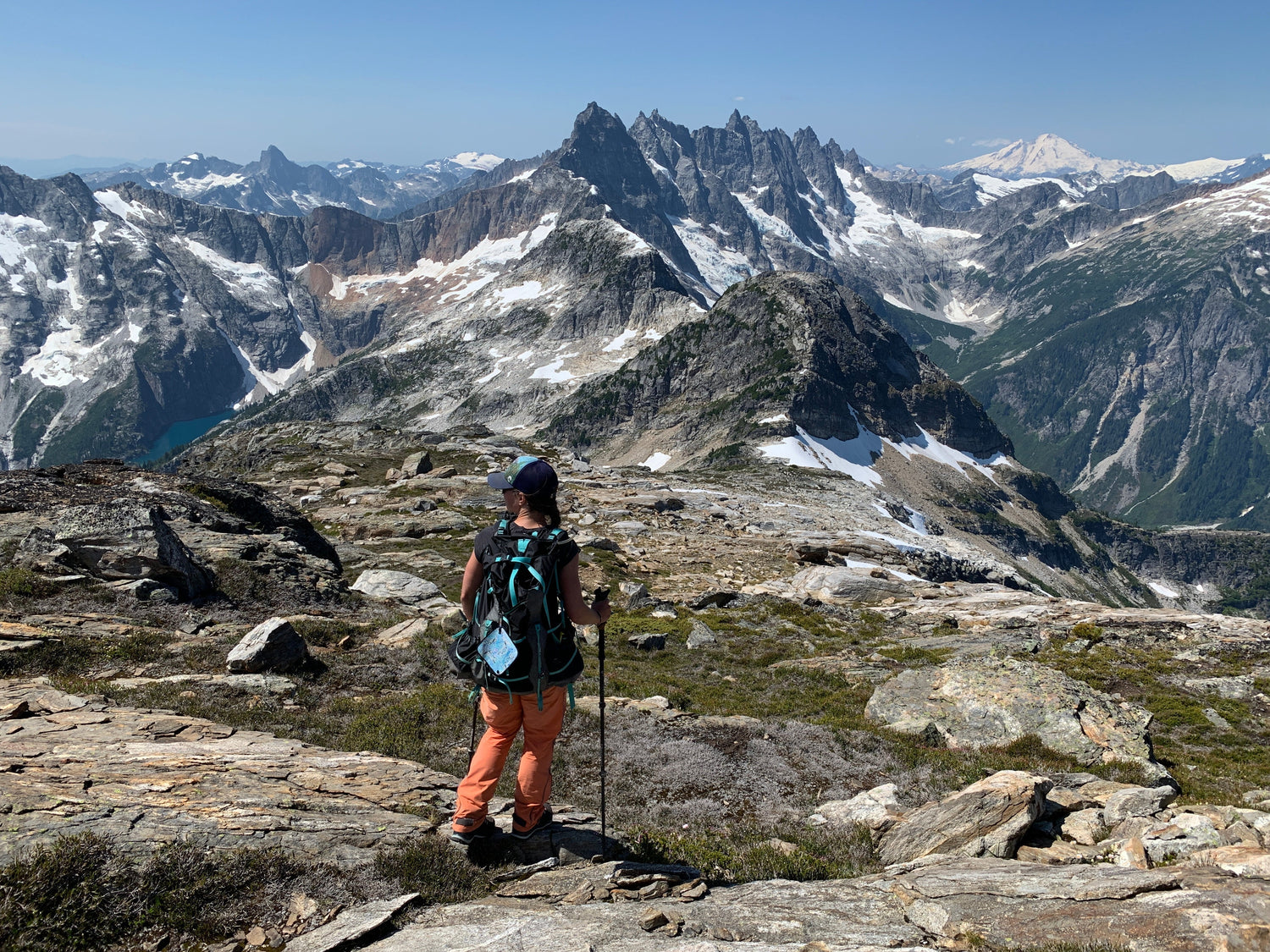
There is never a wrong place or wrong time to start hiking. There's only ever right now.
Hey, friends.
My name is Anastasia Allison. I'm the founder of Kula Cloth, and I'm a former park ranger, wilderness first responder, and avid hiker, backpacker, and mountaineer. I have hiked and backpacked and mountaineered all over the world, which means that I've spent a lot of time outside and a lot of time refining the gear that I know is important for me to bring on both hiking and backpacking trips.

My plan with this series is to try and compile all of that information into a series of posts all about helping you prepare for your first trip. If you're new here, welcome. There is never a wrong place or wrong time to start hiking. There's only ever right now, and there's only ever this one life. My hope is that this information will help you get out there and enjoy it and see why it's such a life-changing and important practice to spend time outside.
1question oneWhat Should I Pack for a Day Hike?
I've been on far too many day hikes where I've seen folks carrying either absolutely nothing with them or just a single water bottle. There are not too many good search-and-rescue stories that begin with the sentence, "And then I packed a single eight-ounce water bottle to go on my hike."
Anytime we're venturing outside, it's so important to bring along the basics that will keep us safe in the event of an emergency. And I want to be clear that I'm not saying this to fearmonger. I'm saying this because it's my goal to help you prepare for everything to go right on your hike. So pull out a backpack. Any backpack will do. The lighter, the better. And get ready to fill it with a few things that are important.
The Ten Essentials
First up are the Ten Essentials. This is a list of items recommended to be carried by every hiker, no matter how far you're going. They include the basic things you will need to assist yourself along the trail, help make your experience more comfortable, and take care of yourself if something doesn't go according to plan.
the modern Ten Essentials — every hike, every time
Many years ago, when I first moved to Washington State, I didn't realize how early it got dark in the afternoon during the winter. A friend and I went to hike Mount Si, a relatively large local day hike, and neither of us brought a flashlight or headlamp. This was in the early 2000s, and all I had was a miniature Nokia phone. There was no iPhone with a built-in flashlight, so we fumbled our way down the trail by the light of our tiny LED phone screens.
The trail was icy and slick, and the entire situation was not great. That was the last time I ever hiked without a headlamp in my pack. The Ten Essentials are called essentials for a reason. Don't leave home without them.
Food
The amount of food you're going to bring is obviously dependent on the length of hike you're doing. If you're doing an hour-long hike on a local trail, you might only need a tiny snack in your pocket, whereas if you're going on a ten-mile hike, you'll probably want something more substantial. I always keep an extra bar in my backpack just in case I need a little something extra. If the hike goes longer than planned, you'll want to have some energy to get yourself out of there.

Water
Water can be tricky because each person has different needs, and some folks drink far more than others. Just because your hydration bladder is three liters in size doesn't mean you need to fill all three liters if you're going on a one-mile hike. If it's really hot outside, you might want to bring more water. If you're hiking in an area where there is an ample water supply, you might take advantage of the opportunity by carrying less water and bringing along a filter so you can refill en route.
That being said, it's very important to stay hydrated, particularly in cold weather when we often don't have the urge to rehydrate as much. Pay attention to your own needs. An eight-ounce plastic water bottle is typically not enough for any substantial hike.
Options include using a hydration bladder, carrying bottles in your backpack, or finding a pack with shoulder holsters. You can also purchase separate shoulder holsters from companies like Trekker Joe's or Chicken Tramper Ultralight Gear and carry your water bottles on the front of your pack so they're easily accessible. There's a lot of debate about which option is better. I can do either, but I know that having a hydration bladder makes it difficult to see how much water I have left. Some people like the visual aspect of bottles because they can actually see how much they're drinking.
Ultimately, the best hydration system is the one that works for you and makes it easy for you to actually drink your water.
Trekking Poles
I'll be honest with you: when I first saw somebody hiking with poles, I thought it was dumb. I didn't understand why anybody would hike with poles.
That was until I did my first big hike and came to a stream crossing and suddenly found myself very off balance — while I noticed that the folks with poles were easily navigating the section.
I've also noticed that my hands tend to swell up and get puffy and uncomfortable if I'm not using poles.
And it turns out the science backs up what my knees and my puffy hands already figured out. Poles help in two big ways: by reducing the impact on your knees, and by helping you on the ascent — getting your arms involved in the activity so that you can pull yourself upwards more effectively.
Researchers have actually measured this. A 2020 review in Wilderness & Environmental Medicine found that hiking with poles may reduce joint loading in the lower body by up to 16%, and that on loaded uphill climbs, poles dramatically increase how much work your arms contribute — while hikers actually reported the effort feeling easier. Other published research has reported that poles can reduce lower-limb joint forces by as much as 25% during downhill walking.
The exact numbers vary from study to study — but the direction is consistent: poles take load off your legs and put your arms to work.
I don't do a day hike without poles. If there's one tip that I can give to any new hikers, it is to always carry trekking poles, no matter what.
My very favorite pair of trekking poles is the Black Diamond Alpine Carbon Cork poles, but there are also some much more budget-friendly options usually available at Costco, or even some at REI.

2question twoWhat Should I Wear Hiking?
What you wear while hiking matters because the ultimate goal of your clothing system should be to manage moisture. When you hike, you're going to sweat. If you're wearing cotton, that sweat is going to soak your shirt, and your cotton T-shirt will not dry quickly. In perfect conditions, this might not be an issue, but if the weather turns or you get stuck out longer than expected and temperatures dip in the evening, you could find yourself in trouble.
Keep in mind that the elevation of the place you're going matters, too. Here in Washington State, I pack a puffy jacket into my backpack nearly year-round because even in the middle of summer, at 6,000 feet elevation, it can get really cold overnight. Even though it might be 70 degrees when I leave my car, the circumstances later in the evening could be entirely different. If something happened and I were delayed, and all I had on was a wet cotton T-shirt, I'd be making myself much more susceptible to hypothermia.
In general, I recommend clothing made from synthetic materials or merino wool. When you're selecting your underwear, pay close attention to the crotch construction. Many pairs of underwear are made from synthetic material on the body but have a layer of cotton in the crotch, and nobody wants to have a wet crotch for multiple days at a time.
My Summer System
- Trail runners
- Merino wool or synthetic hiking socks
- Synthetic or merino wool underwear
- Lightweight synthetic shorts
- Synthetic sports bra
- Synthetic or merino wool shirt
- Long-sleeve layer (worn or carried) — I usually carry a Jolly Gear sun shirt, an Alpine Fit base layer, or a Town Shirt sun shirt
- Ball cap + sunglasses
- Lightweight puffy in the bottom of my pack — always
- Lightweight gloves if it could get cold later
My Fall System
- Trail runners + hiking socks, same as summer
- Hiking pants instead of shorts
- Puffy jacket
- Lightweight fleece
- Warm hat or earband if there's a chance of cold-weather hiking
The most important thing is to adjust the system for you and for the conditions you're actually going to encounter. I went on a hike last November where I saw a woman who was very warm at the trailhead and had headed out wearing a tank top and leggings, even though it was in the low 40s. Less than a mile into the hike, her skin was numb and she was turning around because she realized she had vastly underprepared for the conditions.
Remember that the second you stop moving in cold weather, your sweat will do its job and start cooling you down. You need to be prepared for that possibility, even if you feel perfectly warm when you leave the trailhead.
3question threeHow Do I Stay Safe on a Hike?
The most important thing you can do to stay safe on a hike will happen before you ever leave the trailhead, and that is to research your hike thoroughly so you know exactly what to expect and aren't going on a hike that is far beyond your abilities.
Staying safe is really about packing properly, wearing the proper attire, and doing your research ahead of time. Before you ever set foot on the trail, you should know:
- The approximate mileage and elevation gain.
- What the current conditions are, and whether there's anything important you need to know about the route. Is there snow? Are there creek crossings? Are there washouts? Is the road to the trailhead even open? These are all things that are worth knowing before you get there.
- Your map — downloaded onto your cell phone before arriving at the trailhead. Once you don't have cell service, you might not be able to download the map. I use apps like AllTrails and Gaia GPS, but whatever navigation system you choose, make sure you know how to use it before you actually need it.
Tell Somebody Where You're Going
I call this having a float plan, and the Washington Trails Association has a great form that you can use as a guide. Look at the information on the form, fill it out for your own hike, and make sure you send it to a responsible friend or family member who will actually be paying attention to whether or not you arrive back from your hike at your anticipated time.
If something happens and you don't come home, you want somebody to know exactly where to start looking.
The other thing I do on my hikes is bring along a Garmin inReach. Many newer cell phones have some satellite messaging and emergency capabilities now, which is fantastic, but cell phones can still be fallible. I like having a rugged, purpose-built satellite communicator with me, so I continue to carry my Garmin inReach. In the event that something goes terribly awry, it gives me another way to communicate and activate an emergency response.
Once you're actually out on the trail, listening to your body is one of the most important things you can do. If you find yourself feeling off or something simply doesn't feel right, above all things, trust your gut and your intuition. Many people have run into trouble because of summit fever and because their ego prevented them from turning around and walking back to the car. There are very few people for whom trouble has arisen because they made the decision to turn around when they had an uncomfortable feeling.
Trust your gut, and set yourself up for success by packing the right things so you have the peace of mind that allows you to focus on the task at hand. You want to be able to remain alert and aware of your steps, your movements, the trail, the weather, and what's happening around you instead of panicking because you aren't prepared.
If something does go awry on your hike, believe it or not, the thing that causes havoc is often not the original problem itself—depending, obviously, on what that problem is—but rather people's panicked reactions to it. If you find yourself in a situation that feels overwhelming, one of the best things you can do is take deep, mindful breaths and slow down your nervous system so that you can access your cognitive ability to navigate the situation.
Slow is fast.
By that, I mean that when you calm your nervous system down and can rationally think through a situation, you will be far more likely to navigate it successfully than if you're doing so in a frantic and panicked manner.
4question fourHow Do I Pee and Poop While Hiking?
Let's talk about the thing that everybody eventually has to do outside but that nobody really wants to ask about: going to the bathroom.
If there's a restroom or privy at the trailhead or somewhere along the trail, fantastic. Problem solved. But you should always be prepared for the possibility that there won't be one, which is why I recommend carrying a very simple hygiene kit in your day pack.
For peeing, I carry a Kula Cloth, which is a reusable pee cloth that allows you to pat dry instead of using toilet paper. It's an incredibly simple way to stay cleaner and drier while you're outside without leaving toilet paper behind. After you use it, it snaps onto the outside of your backpack, and you can wash it when you get home.
For pooping, I recommend carrying a small amount of toilet paper and a lightweight trowel in case there isn't a privy available. Depending on where you're hiking, you may be able to dig a cathole for human waste, or you may be required to pack your waste out in a WAG bag. This is another reason why researching your hike ahead of time matters. Bathroom regulations vary dramatically depending on the environment and land manager, so know the rules for the place you're visiting before you need to poop.
You might also want to throw a couple of wet wipes into your hygiene kit. Just remember that wet wipes need to be packed out, even if the package says they're biodegradable. I also always recommend having a dedicated bag for packing out toilet paper and other hygiene waste, along with some hand sanitizer or another way to clean your hands afterward.
Your bathroom kit doesn't need to be complicated:
- A Kula Cloth
- A little toilet paper
- A trowel
- A couple of wet wipes
- Hand sanitizer
- A bag for packing out waste
That will prepare you for most ordinary day-hiking bathroom situations.

Once you've gone to the bathroom outside a few times, you'll realize that it really isn't a big deal. It's simply another normal part of spending time outside, and there's something incredibly freeing about knowing that you can confidently take care of yourself wherever your adventures take you.
5question fiveWhy Do People Love Hiking So Much?
Most importantly, use your time in the backcountry and the wilderness to be mindful, present, and have fun.
If you've never hiked before, then it's very likely that you've spent the majority of your life lost in the trail of your mind, which has a tendency to take you every which way. What you will discover, and what so many millions of people have discovered, is that the moment you set foot on the trail, life becomes a lot more simple.
Instead of needing to figure out every problem or situation, suddenly there's a sense of peace. Clarity and presence arise from that peace, and suddenly you have the awareness to see and feel your part in this big cosmos. It's a really beautiful and overwhelming experience, especially if you've never felt it before.

I think this is what keeps people coming back to hiking over and over again: the feeling of connection with all things. There is a way of existing in this world that is very different when you know that these beautiful places exist out there for all of us to enjoy. Truly, they are a deep reflection of the beauty that lives in each human, and it is my greatest hope that more and more people have the ability to see and feel that and then take that knowledge with them and extend that love to others.
Ultimately, at the deepest level, that is what this is all about. Yes, it's fun. Yes, the gear is cool. But there's something bigger going on here. And the more prepared you are, the more you will be able to experience the bigness that you went out there for.
You don't have to earn the trail. It's been waiting for you — exactly as you are — this whole time.
zip it back up ↩The more prepared you are, the more you will be able to experience the bigness that you went out there for.

So, happy trails, friends. I hope your adventures lead you to beautiful, unexpected, wonderful places for the rest of your life.
Love,
Anastasia
Founder, Kula Cloth®

Anastasia Allison
Anastasia is the founder of Kula Cloth, a former park ranger, and a wilderness first responder who has hiked, backpacked, and mountaineered all over the world. She writes the New Hiker Series to help you prepare for your first trip — because there is never a wrong place or wrong time to start hiking. There's only ever right now.
0 comments